

Suicide Prevention in Primary Care: Western New York Initiative
Primary care providers play a critical role in suicide prevention. National and local data show that many individuals who die by suicide have seen a medical provider shortly before their death. In Erie County, nearly 100 individuals died by suicide in 2025, and a large proportion had recent contact with a primary care clinician—often within 30 days, and in some cases within 24 hours, of their death. This initiative is designed to equip Western New York physicians and care teams with practical tools to identify risk and connect patients quickly to the right level of help.
Through a generous grant from the Western Region Addiction Resources Collaborative and in partnership with the Suicide Prevention Coalition of Erie County, Crisis Services, and the Medical Society of the County of Erie, we are reaching out to medical practices across Western New York with training and tools tailored for busy primary care settings. The focus is on realistic, actionable steps: recognizing warning signs, having effective conversations, and linking patients to appropriate crisis and mental health resources.
Education for Primary Care
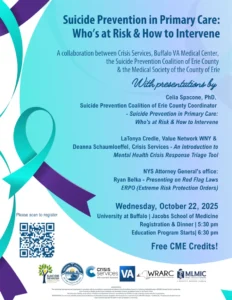
As part of this effort, Dr. Celia Spacone has developed and delivered a presentation, “Suicide Prevention in Primary Care,” which reviews:
- Key risk factors and warning signs for suicide in adults and older adults.
- How often do patients who die by suicide see primary care shortly before their death?
- Practical approaches to asking about suicide risk and responding to disclosures.
Practices are encouraged to review Dr. Spacone’s slide deck and use it as a foundation for team discussion and workflow planning.
Mental Health Crisis Response Triage Tool
A cornerstone of this initiative is the Mental Health Crisis Response Triage Tool, a regionally developed guide to help clinicians and staff triage patients in mental health crisis and connect them to the right level of care. The tool:
- Organizes situations into four levels (A–D), from severe/imminent risk to non‑urgent concerns.
- Provides examples of typical presentations at each level (e.g., overdose, suicide attempt in progress, acute suicidal ideation with plan and means, escalating psychosis, moderate distress without imminent risk).
- Outlines recommended actions for each level, including when to call 911, Crisis Services, or CARES (for youth), when to engage mobile or behavioral health teams, and when to rely on outpatient and peer-support resources.
- Lists 24/7 and non‑24/7 resources, including ECMC CPEP, VA services for veterans, crisis centers, mobile crisis teams, warm lines, and community agencies, along with adult, youth, addiction, and peer-support hotlines.
The triage tool is not a diagnostic test or stand‑alone clinical screener. It is intended as general guidance to be used in conjunction with clinical judgment, supervision, and existing practice protocols, to support consistent, safe responses during a crisis.
Mental Health Crisis Response Triage Tool (Embedded)
The Mental Health Crisis Response Triage Tool is a quick-reference guide to help clinicians and staff determine the level of mental health crisis risk (A–D) and connect patients to the appropriate level of care. It summarizes typical presentations, recommended actions, and referral options, along with crisis hotlines and peer-support numbers.
We recommend printing and posting this tool in clinical work areas and incorporating it into your practice protocols. A high‑resolution PDF version is available for download on this page so that you can share it with your team and integrate it into your electronic resources.
Short Training Video
To support implementation, a ~23‑minute virtual training video walks through the triage tool step by step, using real-world scenarios to illustrate:
- How to recognize each risk level (A–D).
- How to use the tool during phone triage or in‑office encounters.
- When to call 911, crisis lines, mobile crisis, or other resources.
We strongly encourage physicians, nurses, behavioral health staff, and front‑desk or call-center staff to watch the training together and discuss how to adapt the tool to your workflows.
QPR Training for Medical Practices
In addition to the triage tool, practices are being offered free QPR (Question, Persuade, Refer) suicide-prevention training for physicians and staff (including NPs, PAs, RNs, case managers, and social workers). QPR is a widely used, evidence‑informed gatekeeper training that teaches participants how to:
- Recognize the warning signs of suicide.
- Ask direct, compassionate questions about suicidal thoughts.
- Persuade individuals to accept help and connect them with appropriate resources.
Multiple in‑person and virtual sessions are available, with in‑person participants receiving resource materials and a QPR booklet for their office. Practices are invited to register their teams for one of the available sessions.
How to Use This Page
Use this page as a practical toolkit for integrating suicide prevention into everyday primary care.
- Download the Tool – Save and print the Mental Health Crisis Response Triage Tool for use at your front desk, nurse triage, and in clinical work areas.
- Watch the Training – View the 23‑minute video as a team to learn how to apply the tool in real‑world scenarios.
- Schedule QPR for Your Practice – Register your physicians and staff for a free QPR training session to build skills in recognizing risk, asking about suicide, and connecting patients to help.